 September 9, 2026
Payment processing is changing rapidly in 2026. Customers expect faster transactions, easier checkout experiences, more payment options, and stronger security. At the same time, businesses are looking for reliable payment infrastructure that can support growth without creating unnecessary fraud, chargeback, compliance, or settlement problems.These changes are especially important for high-risk businesses. Companies operating in industries such as iGaming, gaming, forex, adult entertainment, travel, supplements, digital products, online education, subscriptions, and other higher-risk sectors can face additional challenges when applying for a high risk merchant account or payment gateway.
For businesses targeting customers in the USA and UK, understanding the latest payment processing trends can help them make better decisions about their payment infrastructure. The goal should not simply be to find the lowest processing fee. Businesses also need to consider transaction approval, fraud prevention, chargeback management, settlement speed, payment methods, security, and long-term scalability.
In 2026, several developments are shaping the payment industry. Artificial intelligence, real-time payments, digital wallets, tokenization, and more flexible payment infrastructure are becoming increasingly important. For high-risk merchants, these developments can influence both customer experience and the stability of their payment operations.
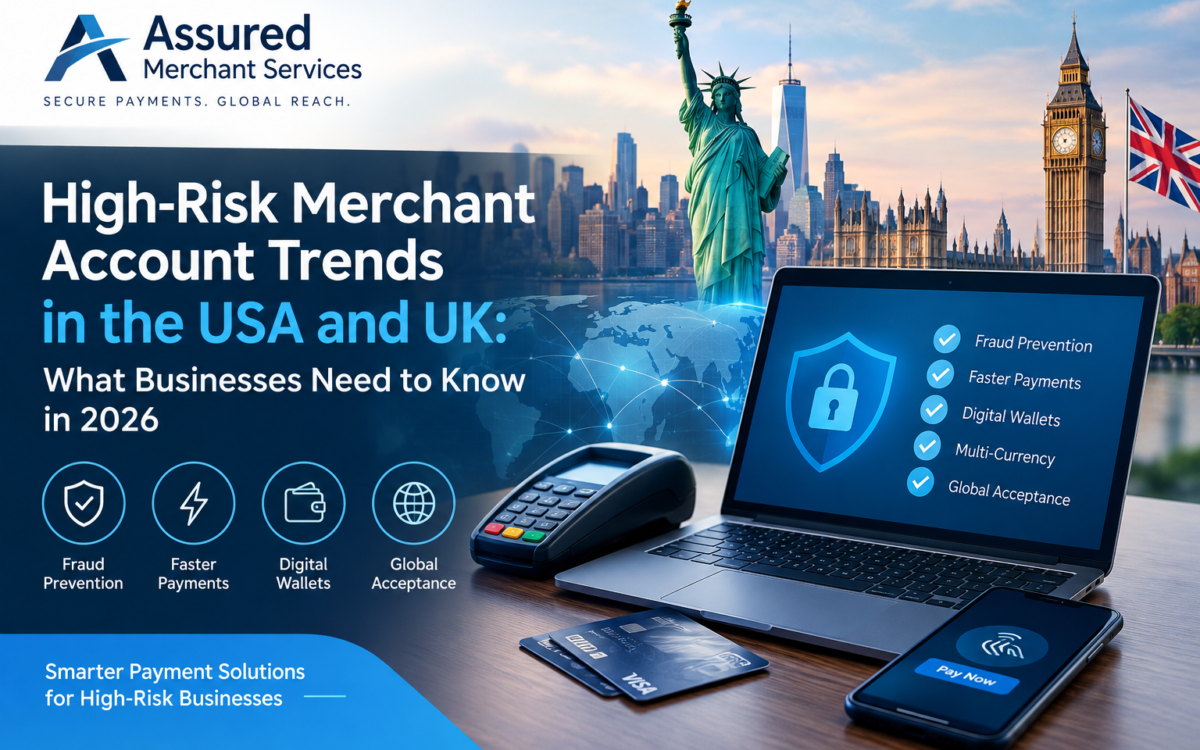
Here are five payment processing trends that high-risk businesses in the USA and UK should watch in 2026.
1. AI-Powered Fraud Prevention Is Becoming More Important
Online fraud continues to evolve as businesses process more transactions through digital channels. Traditional fraud prevention systems often rely on predefined rules, transaction limits, location checks, IP addresses, and other individual signals. While these controls remain useful, payment providers are increasingly using artificial intelligence and machine learning to identify more complex transaction patterns.
AI-powered systems can analyse multiple signals at the same time and identify unusual behaviour that may indicate fraud. Instead of simply asking whether a transaction exceeds a particular amount, modern systems can consider transaction history, customer behaviour, device information, location, purchasing patterns, and other risk indicators.
This development is particularly important for high-risk businesses because fraud and chargebacks can directly affect payment processing relationships. Excessive chargebacks can result in additional scrutiny, higher reserves, increased costs, or difficulty maintaining a stable merchant account.
For this reason, fraud prevention should be considered part of the overall payment strategy rather than an optional feature.
Businesses should look for payment processing services that combine transaction monitoring, fraud screening, customer verification, and chargeback management. Assured Merchant Services’ payment processing service supports high-risk payment gateway integration, high-risk merchant account setup, credit card processing, and recurring billing. payment processing services
The objective is to find the right balance. An overly aggressive fraud system can reject legitimate customers, while weak fraud controls can allow fraudulent transactions to pass through. Both situations can negatively affect revenue.
For high-risk merchants in the USA and UK, the most effective approach is to build a payment environment that protects transactions while keeping the checkout experience as simple as possible for genuine customers.
2. Faster Payments Are Changing Business Expectations
Payment speed is becoming increasingly important for both customers and businesses. Consumers want transactions to be completed quickly, while businesses want faster access to their funds and better visibility into cash flow.
Real-time and faster payment infrastructure is developing across major markets. In the USA, systems such as FedNow and RTP are supporting faster account-to-account payments. The UK has also developed a strong faster-payment environment, giving consumers and businesses greater expectations around transaction speed.
For merchants, faster payment infrastructure can provide several advantages. Businesses may be able to improve cash-flow management, reduce delays, and provide customers with more convenient payment experiences.
This can be particularly useful for companies processing large transaction volumes. Even a small improvement in settlement efficiency can become meaningful when hundreds or thousands of transactions are processed every month.
However, high-risk businesses should not assume that a faster payment option automatically means faster access to funds. Settlement timing can depend on the payment provider, acquiring bank, merchant agreement, risk controls, reserves, and transaction history.
Before choosing a payment processor, businesses should understand how settlement works, when funds become available, whether rolling reserves apply, and how refunds and disputes are handled.
For businesses serving customers in both the USA and UK, payment speed should therefore be evaluated alongside reliability, compliance, and account stability.
3. Digital Wallets Are Becoming a Core Checkout Option
Digital wallets have become an important part of online payments. Many customers prefer not to enter their card information manually every time they make a purchase. Instead, digital wallets allow customers to use stored payment credentials and complete transactions with fewer steps.
This is particularly relevant for mobile commerce. As more customers browse, shop, and subscribe through smartphones, reducing friction at checkout can become an important part of the customer experience.
For businesses serving customers across the USA and UK, supporting convenient payment methods can help create a more flexible checkout experience. However, high-risk merchants need to understand that not every payment method is available to every business.
Payment method eligibility can depend on the merchant’s industry, business model, location, acquiring relationship, compliance profile, and processing history.
A business should therefore confirm whether its payment provider can support the payment methods it wants to offer before building its checkout strategy around them.
A strong online payment gateway can play an important role here by connecting customers, merchants, payment networks, and financial institutions while helping businesses manage online transactions securely. Assured Merchant Services provides online payment gateway solutions designed for high-risk industries, international customers, online businesses, and multi-currency payment processing. online payment gateway
For high-risk merchants, the objective is not simply to offer every possible payment method. The objective is to provide payment options that are suitable for the business, its customers, and its compliance requirements.
4. Tokenization and Payment Security Are Becoming Standard
Security continues to be one of the biggest priorities in online payments. Customers expect businesses to protect their financial information, while merchants need to reduce their exposure to sensitive payment data.
Tokenization is one technology helping businesses achieve this goal. Instead of repeatedly exposing sensitive payment credentials, tokenization replaces payment information with a unique token that can be used within an authorized payment environment.
This can help reduce exposure to sensitive payment information while supporting recurring payments and repeat transactions.
Security is particularly important for high-risk merchants because fraud, disputes, and payment-related security incidents can create additional operational and financial challenges.
Businesses should therefore evaluate the security capabilities of a payment provider before choosing an account. A provider that appears inexpensive based on transaction fees may become costly if the business experiences unnecessary fraud, poor transaction approval, excessive chargebacks, or payment interruptions.
Assured Merchant Services’ online payment gateway page highlights PCI-compliant infrastructure, fraud monitoring, chargeback protection, secure payment processing, and multi-currency support.
For businesses operating in the USA and UK, payment security should therefore be viewed as part of the complete customer experience rather than simply a technical requirement.
5. Flexible Payment Infrastructure Is Becoming More Valuable
As businesses expand internationally, payment processing can become more complicated. A company may need to accept multiple currencies, support different payment methods, work with customers in different countries, and manage different transaction requirements.
This is one reason flexible payment infrastructure is becoming increasingly valuable.
For example, an online business that starts in the USA may later begin selling to customers in the UK and other international markets. Its payment requirements can change as transaction volumes increase and the customer base becomes more geographically diverse.
For international businesses, an offshore merchant account may be another payment option worth evaluating depending on the company’s structure, markets, industry, and compliance requirements. Assured Merchant Services describes offshore merchant accounts as solutions that can help businesses access global markets and handle multiple currencies, while emphasizing the importance of AML and KYC compliance. offshore merchant account
This can be particularly relevant for businesses that serve customers internationally or have difficulty obtaining suitable domestic payment processing.
However, an offshore merchant account is not automatically the right solution for every company. Businesses should consider their target markets, corporate structure, transaction volume, currencies, compliance obligations, and payment requirements before choosing this type of account.
The larger trend is that merchants are increasingly looking at payment processing as business infrastructure rather than simply a way to collect money.
What These Payment Trends Mean for High-Risk Businesses
The major takeaway from these trends is that payment processing is becoming closely connected to business growth.
A merchant account is not simply an account that allows a company to accept card payments. Payment infrastructure can influence customer experience, conversion rates, fraud exposure, chargebacks, cash flow, and the overall stability of a business.
This is especially important for high-risk merchants.
A business may have a strong product and growing customer demand but still experience payment problems if its processor does not understand its business model or industry.
Before applying for a high-risk merchant account, businesses should ensure that their website clearly explains their products or services. Business information should be accurate, ownership documents should be available, and refund, billing, shipping, and customer-support policies should be clearly presented where applicable.
Merchants should also be prepared to provide information about expected transaction volume, average transaction size, customer locations, previous processing history, and chargeback levels.
A clear and complete application can make it easier for an acquiring partner to understand the actual risk associated with the business.
Why Ecommerce Businesses Need the Right Payment Infrastructure
Ecommerce businesses have unique payment requirements because the entire customer journey takes place online. A customer can discover a product, visit a website, enter payment information, and complete a transaction within minutes.
Any unnecessary friction during that process can create abandoned carts.
This is why choosing the right ecommerce merchant account can be important for online businesses. Assured Merchant Services specifically highlights payment processing, digital payment solutions, and the importance of having the right ecommerce merchant account for online conversion. ecommerce merchant account
For high-risk ecommerce businesses, the payment setup becomes even more important because the company may need additional fraud controls, recurring billing support, chargeback management, or specialized underwriting.
The right infrastructure should therefore support both payment acceptance and long-term business growth.
How to Choose a High-Risk Merchant Account in the USA or UK
Choosing a high-risk merchant account should involve more than comparing transaction fees.
A provider may advertise a low rate, but the total cost of payment processing can also depend on monthly fees, reserves, chargeback fees, settlement terms, minimum processing requirements, and other contractual conditions.
Businesses should also consider whether the provider understands their particular industry.
The payment requirements of an iGaming company can be very different from those of a software company, subscription business, travel company, or online retailer. A provider with experience in the merchant’s industry may be better positioned to understand the company’s transaction patterns and risk profile.
Geographic coverage should also be considered. Businesses serving customers in both the USA and UK should understand which currencies and payment methods are supported and how international settlements are handled.
Customer support is another important consideration. Payment issues can directly affect revenue, so merchants should have access to responsive support when transactions, settlements, chargebacks, or account issues arise.
Ultimately, the best payment processing solution is not necessarily the cheapest one. It is the solution that provides an appropriate balance between cost, reliability, security, approval, customer experience, and scalability.
The Future of Payment Processing for High-Risk Merchants
The payment industry is moving toward faster transactions, smarter fraud detection, greater payment flexibility, and more secure digital experiences.
AI will continue to influence fraud prevention and transaction monitoring. Faster payment infrastructure will continue to improve the speed of moving money. Digital wallets will remain important for online checkout, while tokenization and other security technologies will help businesses protect payment information.
At the same time, businesses operating across multiple markets may increasingly look for payment infrastructure that can support different currencies, payment methods, and acquiring relationships.
For high-risk merchants, the challenge is finding the right combination of technology, compliance, security, and payment accessibility.
Businesses that approach payment processing strategically can put themselves in a stronger position to manage risk while providing customers with the convenient payment experience they expect.
Conclusion
Payment processing is becoming more advanced in 2026, and high-risk businesses in the USA and UK cannot afford to ignore these changes.
AI-powered fraud prevention, faster payments, digital wallets, tokenization, secure online gateways, and flexible payment infrastructure are changing the way businesses accept payments.
However, adopting new payment technology is only one part of the equation. High-risk businesses also need the right merchant account, appropriate underwriting, strong compliance processes, effective chargeback management, and a payment provider that understands their business model.
If your business operates in a high-risk industry and needs reliable payment processing in the USA or UK, the right merchant account can be an important part of building a stable payment infrastructure.
Assured Merchant Services helps businesses explore payment processing and merchant account solutions based on their business model, industry, transaction requirements, and target markets.
If you are looking for a high-risk merchant account, online payment gateway, ecommerce payment solution, or international payment processing option, speak with the Assured Merchant Services team to discuss your requirements.
Frequently Asked Questions
What is a high-risk merchant account?
A high-risk merchant account is a payment processing account designed for businesses that banks or payment processors consider to have a higher level of financial, fraud, regulatory, or chargeback risk. These businesses may have additional underwriting requirements and different processing terms compared with standard-risk merchants.
Why do high-risk businesses need specialized payment processing?
High-risk businesses can face higher chargeback exposure, fraud risks, industry restrictions, or additional compliance requirements. Specialized payment processing providers may have experience working with these business models and can help merchants explore payment solutions that are appropriate for their risk profile.
Can I get a high-risk merchant account in the USA?
Yes, businesses operating in high-risk industries may be able to obtain merchant accounts in the USA. Approval can depend on the business model, industry, ownership structure, processing history, expected transaction volume, website, documentation, and overall risk profile.
Can UK businesses get high-risk payment processing?
Yes. UK businesses operating in higher-risk industries may be eligible for specialized payment processing. Providers generally evaluate the company’s business model, products or services, transaction history, customer base, documentation, and compliance requirements.
How can a high-risk business reduce chargebacks?
Businesses can reduce chargebacks by using clear billing descriptors, transparent pricing, accurate product information, effective fraud monitoring, customer verification, clear refund policies, and responsive customer support. Regular transaction monitoring can also help identify unusual activity.
Are digital wallets useful for high-risk businesses?
Digital wallets can provide customers with a faster and more convenient checkout experience. However, availability can depend on the merchant’s industry, location, payment provider, acquiring relationship, and applicable compliance requirements.
What should I compare when choosing a high-risk merchant account?
Businesses should compare more than transaction rates. Important considerations include processing fees, reserve requirements, settlement timelines, supported payment methods, geographic coverage, fraud prevention, chargeback support, customer service, contract terms, and the provider’s experience with the merchant’s industry.
Is an offshore merchant account suitable for every business?
No. An offshore merchant account is generally considered based on factors such as the company’s international operations, target markets, business structure, industry, currency requirements, and compliance needs. Businesses should evaluate their individual circumstances before choosing an offshore payment solution.